
Daring to Hope
Nobody knows the outcome of tomorrow's election, but there are a few reasons to keep the faith until every vote is counted.

It’s been a while since I’ve written because working on this election means things have gotten busy. I’m writing tonight both to work through my own thoughts, and because many friends have reached out in the last few days to ask me what I think is going to happen tomorrow.
Here is my answer:
I don’t know who will win, and neither does anyone else, but I do have hope. And as scary as it feels to hope, I think you should too. Below are four thoughts (and resources!) to help you get through tomorrow (and quite possibly, the week ahead):
1. Polling indicates this race is close, and it might be. But maybe not…
As Kayleigh Rogers wrote in the New York Times Today, “…polls are best understood in aggregate, because any single poll by itself is prone to a certain amount of error.” As a former pollster, I can tell you this is true. The thing is: we are always guessing at just how much. That guess is informed by statistics, but it’s still very much a guess, because our calculations are based on historical assumptions. There are all kinds of reasons why that guessing game is getting harder. To name a few: young people don’t answer their phones as much and are less likely to participate in phone polls; polls of battleground states like Arizona are often conducted exclusively in English even though ~20% of the population speaks Spanish as a first language; social aquiescence bias means that people are more likely to answer questions in a way that they believe others will find agreeable or socially acceptable; and a decline in social trust in certain communities can lead to an increased number of “refusals” (people who decline to take a poll after answering the phone and being asked). All of these things can skew polling results. And then there’s a loose theory that people who take polls are just…a little different than people who don’t, in a way that’s difficult to pin down in the data.
And not for nothing, some things are just difficult to know based on how people answer questions. I like to use this metaphor: Let’s say you went on a first date, and after the date, you wrote down everything that you and your date said. You hand the transcript to a friend, they read it, and they say “Wow! You two must have really hit it off!” But maybe you didn’t. Maybe you were both polite, and you liked each other enough to agree to a second date, and you share a lot of views and hobbies, and everything on paper makes it look like you are completely compatible, but maybe you have no chemistry, felt no connection, no spark, and no real interest in a second date. Maybe the facial expressions and the body language would tell a completely different story. Maybe they’d completely contradict the transcript, but they’d be much more telling. Most of us have been on some version of this date.
Polls often miss the corporeal, the ephemeral, and the je ne sais quoi of why we are attracted or not attracted to a candidate, because the things we humans say rarely tell the whole story (this is also the main reason that researchers hold focus groups). So polling is helpful in the sense that it is directional, and it is one tool in our toolbox as we try to understand how voters are thinking and feeling. Polls are snapshots of a single moment in time, taken from a single angle. There are all kinds of other angles we just don’t get in a poll, and the extent to which those angles tell us a different story varies from election to election as our context changes.
TLDR; don’t get too hung up on the polls. They might be right. But they might not be. And there’s no way to know until we get the results.
2. Women are voting early (and so are youth!) 🔥🔥🔥
There are a few demographic groups that skew heavily toward Harris and Democrats, and those same groups have been turning out in high numbers during the early vote period across several swing states. As of today, more than 78 million early ballots have been cast nationwide. Yes: this is less than 2020, when 110 million voted early or by mail, but we were in the middle of the COVID pandemic, so more people were incentivized to vote by mail for health reasons. Moreover, while the national numbers are lower than 2020, that is not true in all of the battleground states. Georgia and North Carolina have both reached record early vote numbers.
Women currently account for 53% of early voters nationwide, ahead of men at only 44%. And women are breaking for Harris at record-breaking rates (especially college-educated women). Now, this story has complexity to it, because while Harris and Dems are winning women, they also appear to be losing non-college educated men, so turnout plays a big role in the electoral math. The ratio of women to men voting is an important signal to track. The national early vote numbers only matter so much, so to understand how the gender break might affect the pathway to 270 electoral votes, consider the chart below, based on recent polling from Quinnipiac University.
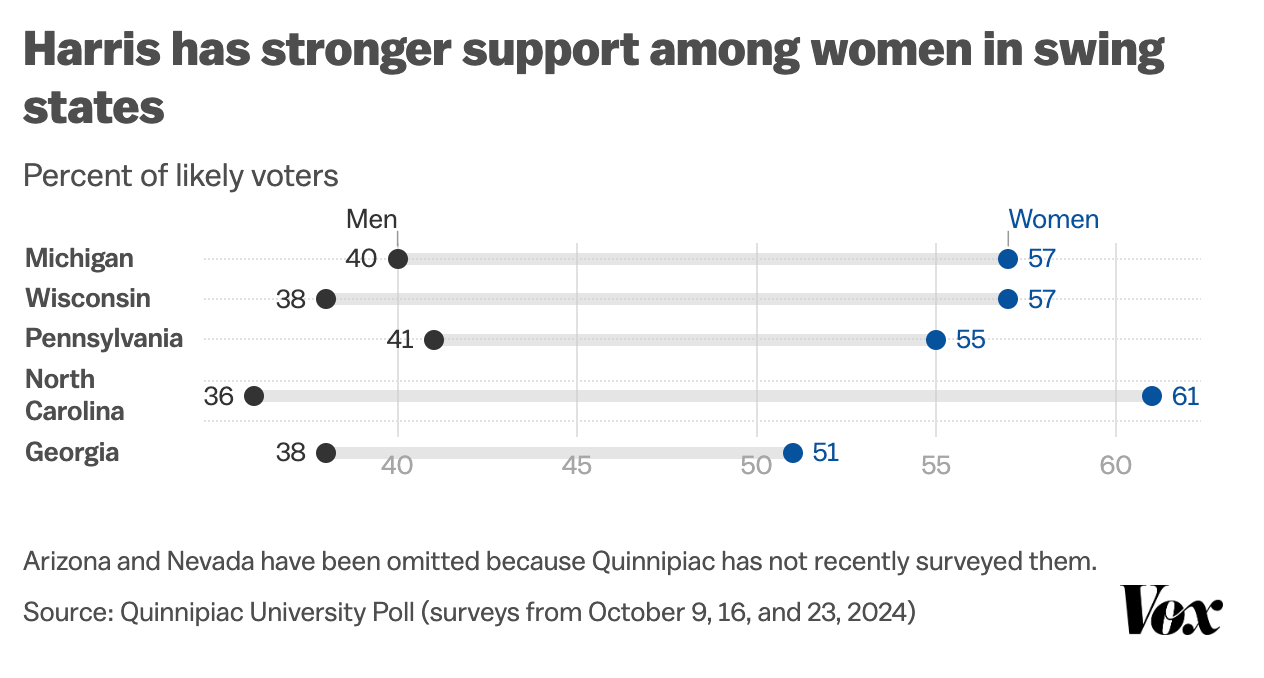
All in all, there is a lot of good signal in the data here. Women support Harris at higher rates than men, and women are voting early at higher rates than men, even more so compared to historic trends.
Here are a few links you can check out about how women are voting early in droves:
Politico: Dems see signs for optimism in gender gap in early voting (10.29.24)
USA Today: Surge of female voters may make the difference for Kamala Harris’ chances (11.4.24)
Los Angeles Times: Women are voting early. Will they deliver the the election for Harris? (11.4.24)
The Cut: MAGA Activists Melt Down Over So Many Women Voting Early (10.31.24)
The New Republic: Team Trump Losing Their Minds Over Stunning Early Voting Numbers (11.1.24)
Word on the street is the youth vote numbers aren’t looking so bad either, particularly in Michigan and Pennsylvania. And youth could unlock the pathway to victory for Democrats in swing states expected to have razor thin margins like Wisconsin.
Seeing supportive demographic groups voting at high rates during the early vote period isn’t just a good sign as a predictive data: it also means campaigns can remove these voters from their contact lists and run more efficient GOTV operations on Election Day.
3. Nobody knows the outcome of this election. But there are some good resources out there on what to expect.
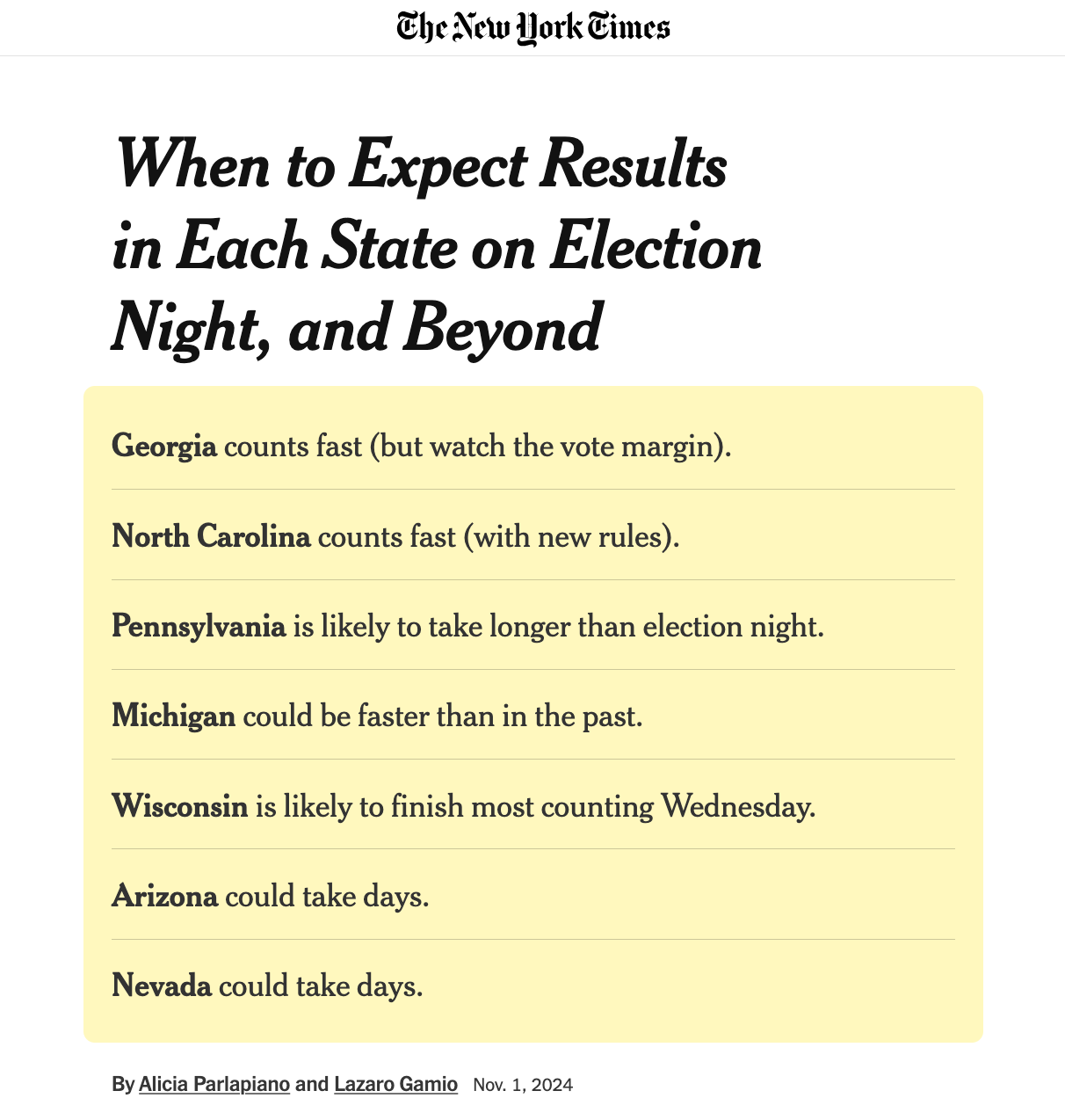
The best resource I’ve seen setting expectations for tomorrow is this page from the New York Times. I know it’s kind of lame to direct you to the NYT, because it’s not exactly flying under the political junkie radar, but they do a damn good job.
The TLDR on expectations for election result timelines in each swing state is in the image below (just beneath the headline), and the piece includes more helpful information on the situation in each state re: vote counting, 2020 and 2022 timelines as reference points, etc.
Their interactive page is also a great resource on the various electoral college scenarios. And of course there is 538’s “What if” tool if you want to play around with different pathways.
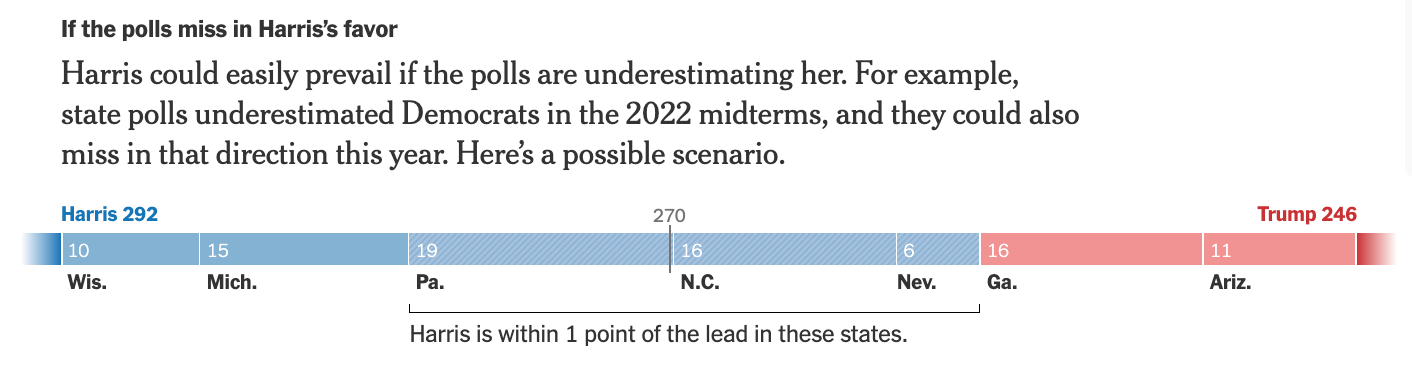
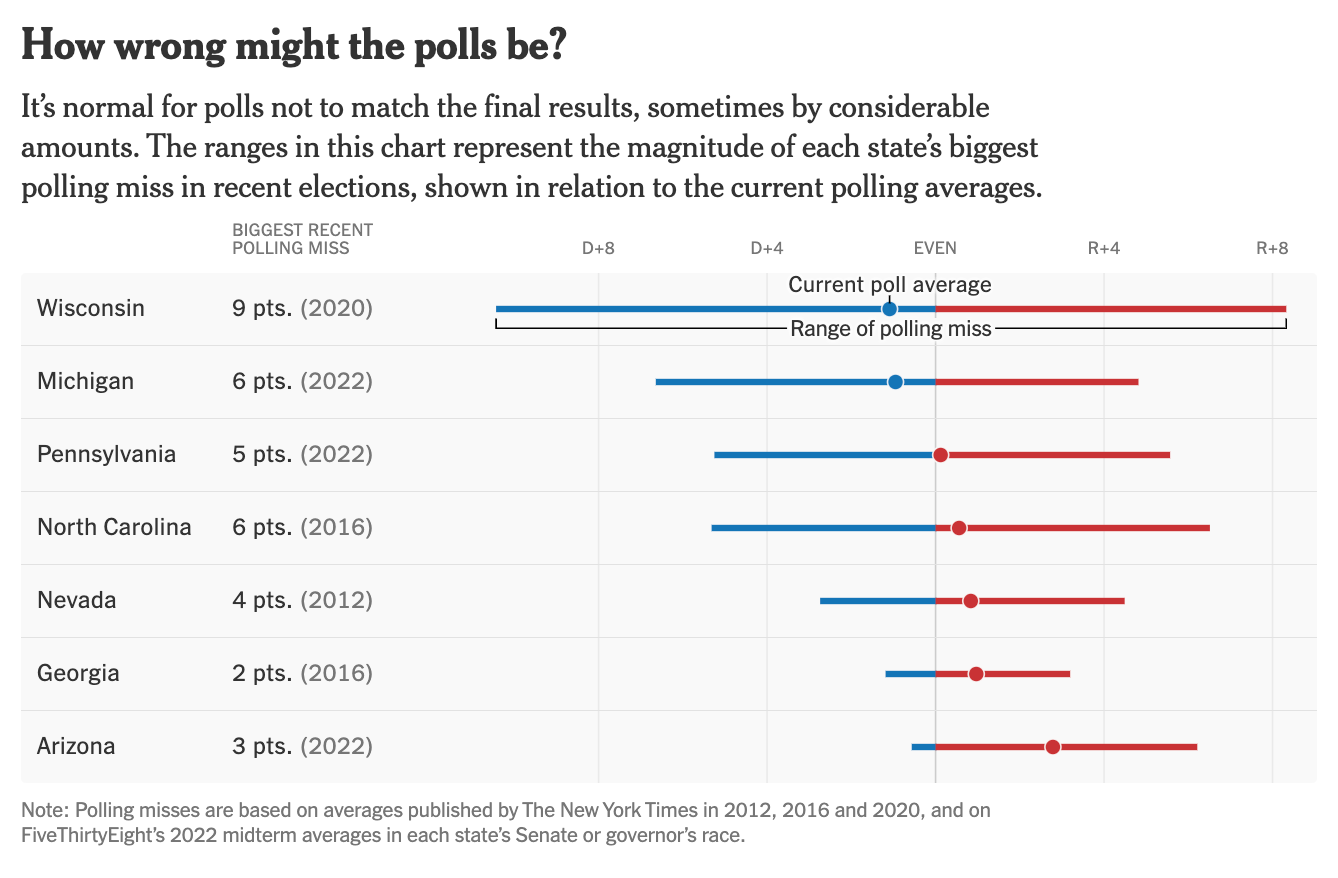
The NYT interactive even includes some helpful information on just how much the polls have missed the results in swing states (look at the range for Wisconsin!)
4. It’s not over until every vote is counted.
Finally…remember that it isn’t over until it’s over, and if we are looking at close margins, we are unlikely to know the result tomorrow night. Keep in mind that Trump is desperate to grab power by any means possible, and may preemptively declare victory even if he is losing badly, because that’s what wanna-be dictators do when they’re trying to sow doubt in elections and overturn the will of the people.
Make sure you are following credible news sources who are making their calls based on counts from state election boards. This election isn’t over until every vote is counted.
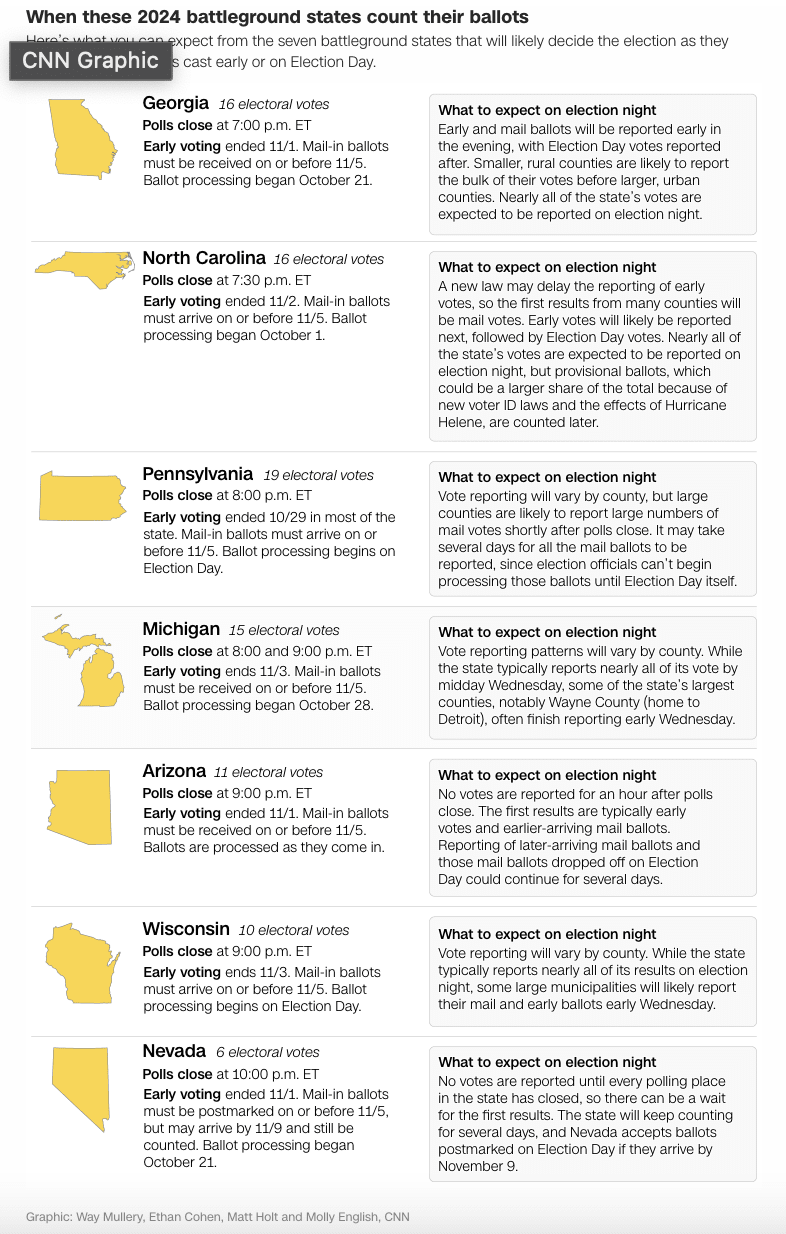
If you live in a battleground state, remind your friends and family that voters who are already in line when the polls close should stay in line, as they are entitled to cast their vote as long as they arrived before closing time. Details on closing times in each swing state are in the CNN graphic below.
I hope this helps you keep the faith tomorrow. Anything could happen, and that’s scary. But it’s also a reason to hope.
If you have friends or family in swing states, send a text or give them a call and make sure they have a voting plan. If you don’t know anyone in a swing state personally, but want to help get out the vote, the Harris campaign has a call tool and will get you trained over zoom. If you know organizers working on campaigns, now is a good time to send some words of encouragement and support (I’m told they are no longer in need of pizza, thanks super volunteers).
I believe that we will win. Either way, let’s leave it all on the field.